Last Updated on June 1, 2026
Table of Contents
Mundilföri and the Cosmic Order
Mundilföri, pronounced MOON dil fur ee, appears in Norse mythology as a mysterious figure connected to the movement of the heavens and the ordering of time. Scholars often interpret the name as relating to motion, turning, or the regular revolutions of celestial bodies across the sky. The surviving sources provide only limited details about his character, yet those brief references have inspired extensive discussion among historians, linguists, and students of Norse tradition.
Several alternate spellings appear in modern books and academic works, including Mundilfari, Mundilfœri, and Mundilfoeri. The spelling Mundilföri reflects the use of the letter ö, which sounds roughly like the vowel heard in the word bird when spoken with a rounded mouth shape. The ligature œ, found in Mundilfœri, is pronounced similarly and often represents a historical spelling variation rather than a different individual.
Mundilföri holds an important place because he stands as the father of two celestial figures, Máni and Sól. Máni, pronounced MOW nee, governs the moon, while Sól, pronounced SOHL, governs the sun. Their connection to Mundilföri suggests that he belonged to a family closely associated with the structure of the cosmos and the passage of time.
The surviving myths indicate that the gods reacted to the remarkable names and beauty associated with Mundilföri’s children. As a result, Sól and Máni received responsibilities that linked them directly to the movement of the sun and moon across the heavens. This narrative connects Mundilföri to the daily and monthly cycles that shaped agricultural life, navigation, seasonal observation, and ritual calendars throughout the Norse world.
The Father of Sól and Máni
The role of Mundilföri extends beyond simple genealogy because his family relationship provides a framework for understanding cosmic order. Norse mythology often presents the universe as an active system maintained through motion, responsibility, and recurring cycles. Through his children, Mundilföri becomes associated with those recurring patterns that allow day to follow night and months to follow one another in a dependable sequence.
Many researchers focus on the possible meaning of his name when interpreting his significance. Linguistic studies frequently connect the name to turning, rotation, or movement, which aligns closely with the paths followed by celestial bodies. Although the surviving texts do not offer a detailed biography, the symbolism surrounding his name creates a strong connection between Mundilföri and the ordered motion of the heavens.
The figure remains somewhat enigmatic because the sources preserve only a few direct references. This limited information encourages careful interpretation rather than certainty. Even so, the placement of Mundilföri within the family of the sun and moon grants him an enduring role in discussions of Norse cosmology and mythological structure.
Mundilföri receives mention in the Poetic Edda and the Prose Edda through references involving Sól and Máni. These works preserve the essential information that identifies him as their father and places his family within the broader mythological explanation of celestial movement. While the references remain brief, they provide the foundation for nearly everything known about him today.
Symbolism and Enduring Interest
Modern interest in Mundilföri often centers on symbolism rather than narrative action. Unlike famous gods who participate in dramatic adventures, he occupies a quieter position that emphasizes cosmic order and continuity. His presence reminds readers that Norse mythology valued regular cycles and dependable patterns alongside heroic deeds and supernatural conflicts.
The association with the sun and moon also gives Mundilföri a lasting relevance within studies of ancient astronomy and mythic thought. Early societies observed the heavens carefully because seasonal change influenced travel, farming, trade, and survival. A figure linked to celestial motion therefore carried significance beyond family relationships and entered a broader framework of understanding the universe.
Because so little direct information survives, Mundilföri remains open to interpretation while still retaining a clear mythological identity. His connection to Sól and Máni, the likely meaning of his name, and his placement within the Eddic tradition continue to make him an intriguing figure for anyone exploring Norse mythology. The combination of mystery and cosmic symbolism ensures that interest in Mundilföri endures across both academic study and popular discussions of the Norse mythic world.
Runes Associated with Mundilföri
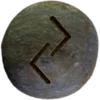
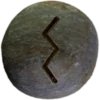
Two Elder Futhark runes often connect symbolically with themes associated with Mundilföri: Jēra (ᛃ) and Sowilō (ᛊ or ᛋ). Jēra (ᛃ), pronounced YEH rah, represents the cycle of the year, harvest, and the dependable return of seasonal change. These meanings align closely with the recurring motions of the heavens and the orderly progression of time reflected through Mundilföri’s connection to celestial cycles.
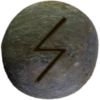
Sowilō (ᛊ or ᛋ), pronounced SOH wee loh, represents the sun, success, vitality, and illumination. Because Mundilföri stands as the father of Sól, the solar deity, Sowilō (ᛊ or ᛋ) provides a natural symbolic association. The rune emphasizes movement, energy, and the visible power of the sun as it travels across the sky each day.
Together, Jēra (ᛃ) and Sowilō (ᛊ or ᛋ) reflect rhythm, continuity, and cosmic order. Their combined symbolism echoes the regular movements of the celestial bodies connected to Mundilföri and highlights the importance of recurring natural patterns within Norse mythological thought.
Mundilföri and His Importance to Asatruar
For many Asatruar, Mundilföri represents the principle of cosmic order that underlies the movement of the sun and moon. His role as the father of Sól and Máni places him within a network of relationships that helps explain how the universe functions according to recognizable patterns and cycles.
Some practitioners view Mundilföri as a reminder of the importance of balance, regularity, and respect for natural rhythms. Seasonal observances, awareness of celestial events, and attention to the passage of time can reflect themes associated with his mythological significance. His connection to recurring motion encourages contemplation of how order emerges through dependable cycles rather than sudden change.
Although he receives less attention than major gods, Mundilföri remains meaningful because he stands near the foundation of the cosmic structure described in Norse mythology. His presence highlights the interconnected nature of family, celestial movement, and the continuing rhythm of the world.