Last Updated on April 18, 2026
Table of Contents

Borr: Ancestral Figure of the Early Gods
Borr, also written as Bor or Burr, stands as a foundational figure in early Germanic tradition, where his name carries a sense of origin and continuity within divine lineage. You can pronounce Borr as “bor” with a long open vowel, similar to the word “bore,” while Burr sounds like “bur” with a softer ending. His presence anchors a lineage that leads directly to the first generation of widely recognized gods, giving him a role that feels both quiet and structurally essential. Rather than appearing as an active wanderer or warrior, he occupies a position that supports the unfolding of later mythic events through his descendants.
Borr is best known as the son of Búri, the primordial ancestor who emerged under extraordinary circumstances, and as the father of three significant figures who shaped the early world. His sons, Odin, Vili, and Vé, become central agents in shaping existence, yet Borr himself remains less dramatized in narrative detail. This contrast creates a compelling dynamic, where a figure of immense importance influences events through lineage rather than direct action. His role highlights how ancestry carried weight in early storytelling, where identity often flowed through family connections rather than individual exploits.
The name Borr connects linguistically to ideas of birth and production, reinforcing his position as a generative figure within divine heritage. Alternate spellings such as Bor and Burr appear in various translations and interpretations, each reflecting slight phonetic differences shaped by regional language evolution. While these variations exist, they all point back to the same central identity, emphasizing continuity across sources rather than contradiction. This consistency allows modern readers to trace his presence even when spellings shift across texts.
Lineage and Symbolic Role
Borr’s marriage to Bestla introduces another layer of significance, as Bestla herself descends from ancient beings tied to the earliest formation of the world. This union brings together two powerful ancestral lines, creating a bridge between primordial origins and the structured order established by their sons. Their offspring do not merely inherit existence; they actively shape it, transforming raw material into organized realms and establishing boundaries that define reality. Borr therefore represents a crucial midpoint, linking raw beginnings with deliberate creation.
His symbolic role extends beyond simple ancestry, as he embodies continuity and the transmission of power across generations without overt dominance or spectacle. Stories rarely describe his actions in detail, yet his influence remains undeniable because his descendants carry forward the structure of existence itself. This subtle presence suggests a cultural appreciation for foundational figures who enable transformation without seeking recognition. Such a portrayal aligns with broader themes of inheritance, where legacy often outweighs immediate visibility.
In surviving sources, Borr appears briefly yet meaningfully, particularly within poetic and prose compilations that preserve early traditions. These texts reference him primarily in genealogical passages, where his placement clarifies the origins of major divine figures. While the narratives focus more heavily on his sons, the inclusion of his name ensures that audiences recognize the continuity of lineage. This brief mention still carries weight, as it situates him firmly within the structure of early mythic storytelling.
Presence in Early Texts
Borr appears in the Prose Edda and Poetic Edda, where authors preserve genealogical frameworks that trace divine ancestry back to its earliest recognizable figures. These works mention him as the father of Odin and his brothers, establishing his place within the lineage that leads to the formation of the world. Although the texts do not expand on his personality or deeds, they ensure his role remains clear and essential. This concise treatment reflects how early traditions often prioritized lineage over detailed characterization for certain figures.
His limited narrative presence does not diminish his importance, as the structure of these texts depends on clear ancestral connections to maintain coherence. By naming Borr, the authors reinforce a chain of origin that legitimizes the actions of later gods and situates them within a broader framework. Readers encounter him as a pivotal link rather than a central actor, which strengthens the sense of continuity across generations. This approach highlights how even brief mentions can carry substantial meaning within structured storytelling traditions.
Runes Connected to Borr’s Legacy
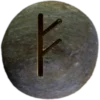
The rune Ūruz (ᚢ) represents raw strength, vitality, and the shaping force that transforms potential into tangible reality, which aligns well with Borr’s position as a progenitor of powerful beings. Its form suggests endurance and foundational energy, echoing how Borr contributes to the emergence of structured existence through his lineage. Another rune, Fehu (ᚠ), symbolizes wealth, growth, and the movement of resources, reflecting how generational continuity creates abundance through inheritance and expansion. Together, these runes capture both the primal force and the generative flow associated with Borr’s role, illustrating how unseen origins support visible outcomes.
Borr’s Importance to Asatruar
Borr holds significance for Asatruar because he represents the continuity of divine ancestry and the importance of generational connection within spiritual understanding. His presence reinforces the idea that origins matter deeply, even when stories focus more on later figures who take visible action. Practitioners often value this sense of rootedness, where identity and purpose emerge from a chain of existence that stretches back through time. By acknowledging Borr, they recognize the quiet strength found in foundational figures who enable transformation without seeking recognition.
This perspective encourages reflection on heritage, responsibility, and the transmission of values across generations within modern practice. Borr’s role highlights how influence does not always require dramatic action, as lasting impact often arises through continuity and support. His place within the lineage leading to Odin and his brothers provides a reminder that every stage of existence contributes to the whole. Borr becomes more than a distant ancestor, as he embodies the enduring connection between origin and outcome.