Last Updated on April 25, 2026
Table of Contents
Svöl and Its Place in the Northern Worldview
The name Svöl, sometimes written as Svol or Svǫl, refers to a chilling river whose presence evokes both danger and endurance within early Scandinavian storytelling traditions. The spelling Svǫl uses the letter ǫ, which sounds like a short “aw” as in “law,” so the name sounds close to “Svawl.” The simpler form Svöl sounds like “Svuhl,” where the ö carries a rounded vowel similar to the “u” in “burn.” These variations show how pronunciation shifts across regions, while the meaning consistently ties to coldness and harsh flow.
Descriptions present Svöl as a river fed by icy sources, often connected to the primal forces that shaped the world’s earliest landscapes. Its waters do not welcome easy passage, and those who approach it must deal with freezing currents that test strength and resolve. Travelers and figures who cross such rivers demonstrate resilience, and the act of crossing marks a transition from one state of being into another. This symbolic role gives Svöl importance beyond simple geography, since it represents both a boundary and a trial.
Writers often associate it with other rivers that originate from powerful wells or springs, reinforcing the idea that water carries memory, fate, and consequence. These rivers carve through lands that reflect struggle and transformation, and Svöl stands among them as one of the colder and more unforgiving examples. Its name alone signals an environment where warmth retreats and survival demands awareness, preparation, and determination. That atmosphere contributes to its lasting presence in discussions of early northern traditions.
Landscape and Symbolic Meaning
Svöl occupies a conceptual landscape where ice, mist, and flowing water merge into a single force that shapes both terrain and narrative meaning. The river’s coldness does not simply describe temperature, since it also conveys emotional distance and the difficulty of facing harsh realities. When figures encounter such a river, they confront more than physical obstacles, because the crossing often reflects internal struggle or the acceptance of unavoidable change. This layered meaning gives Svöl a role that extends beyond a simple environmental feature.
Accounts place Svöl among rivers that flow from ancient sources tied to the earliest formation of the world, which reinforces its connection to origins and enduring cycles. The steady movement of water suggests continuity, while the freezing conditions emphasize resistance and hardship, creating a balance between motion and stagnation. This duality captures a broader theme where life persists despite adversity, and every crossing signals a willingness to face what lies ahead without certainty. Such themes resonate strongly within the wider body of northern storytelling.
Its presence also highlights the importance of natural forces as active participants rather than passive settings within these traditions. Rivers shape paths, determine survival, and influence decisions, which means they hold a form of agency that characters must respect. Svöl’s icy flow demands careful navigation, and those who underestimate it risk failure or worse outcomes. This relationship between human effort and environmental challenge remains central to understanding why such rivers appear repeatedly in narratives and interpretations.
Runes Connected to the Nature of Svöl
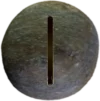
The rune Isaz (ᛁ), found in the Elder Futhark and pronounced “ee-sah,” aligns closely with the cold and unyielding qualities associated with Svöl. Isaz (ᛁ) represents ice, stillness, and concentration, and it captures the sense of a frozen surface that demands caution and balance from anyone who attempts to cross it. This rune emphasizes restraint and clarity, encouraging focus when conditions grow severe and unpredictable. Its presence mirrors the river’s ability to halt movement while simultaneously challenging individuals to adapt.
The rune Laguz (ᛚ), pronounced “lah-gooz,” also connects strongly with it through its association with water, flow, and intuition. Laguz (ᛚ) represents the movement of currents and the unseen forces that guide direction beneath the surface, which reflects how a river like Svöl carries both visible danger and hidden depth. This rune encourages awareness of shifting conditions and trust in one’s instincts when navigating uncertain terrain. Together, Isaz (ᛁ) and Laguz (ᛚ) express the balance between frozen stillness and flowing motion that defines the character of Svöl.
Meaning of Svöl for Asatruar Today
For modern practitioners who identify as Asatruar, Svöl holds meaning as a symbol of endurance, transition, and respect for natural forces that shape existence. The river’s harsh qualities remind individuals that growth often requires facing discomfort and overcoming obstacles that do not yield easily. This perspective encourages a mindset that values preparation, resilience, and the willingness to confront challenges without expecting immediate ease or comfort. Svöl becomes a mental and spiritual reference point rather than a physical location.
Many Asatruar view such rivers as representations of life’s thresholds, where decisions lead to lasting consequences and personal transformation. Crossing a river like Svöl reflects a deliberate step into a new phase, which reinforces the importance of awareness and responsibility during pivotal moments. This interpretation connects ancient imagery with modern experience, allowing individuals to draw meaning from older traditions while applying it to present circumstances. The river’s enduring symbolism continues to influence how practitioners understand struggle and perseverance.